Every October, most of New England funnels itself into two places: Lincoln and North Conway. The Kancamagus turns into a slow parade of brake lights, and every overlook has a tour bus in it.
Meanwhile, an hour north, Coös County runs the same show a week earlier — bigger sky, emptier roads, hillsides just as gold. Lancaster sits in the middle of it, where Routes 2 and 3 cross in a real downtown. Red Fox Inn is on Main Street, 27 rooms with your car parked at your door. This is our guide to leaf season on the quiet side of the White Mountains.
When does the North Country peak?
Color in New Hampshire moves north to south and high to low. Coös is the northernmost county in the state, so we turn first — typically the last week of September through the first week of October, roughly a week ahead of Franconia and Crawford notches and well ahead of everything south of the mountains.
Here’s how it usually unfolds around Lancaster:
- Mid-September: first color. Swamp maples go red in the low, wet ground and the hillsides look salted rather than painted. Photographers like this week more than anyone admits.
- Last week of September: the push. The hills around town go fast — orange and gold climbing a little higher up the slopes every day. This is the sweet spot for the north side.
- First week of October: peak in the valley. The Connecticut River bottomland, the Israel River through downtown, the whole frame lit at once. Usually the best all-around week.
- Second week of October: fading up high, still burning down low — and now the notches to the south are peaking, so you drive toward the color instead of sitting in it.
Every year slides a few days one way or the other. The state publishes a live foliage report each fall — it’s linked in the quick facts above; check it the week before you drive up. If you have to pick one weekend blind, pick the one that straddles September and October.
Where to stay for White Mountains foliage
Here’s the honest version. If you want outlet shopping and a dozen restaurants within a mile, stay south — Lincoln and North Conway exist for that. You’ll just share them with everyone else who had the same idea, on the most crowded weekends of the New Hampshire year.
Lancaster is the other answer. It’s a working county-seat downtown, not a resort strip: a bakery that opens early, a brewery in an old bank basement, a restored movie theater, and an inn that started life as a 1955 motor lodge — which means you park at your own door and unload in ten feet. From here the foliage isn’t a drive away; it’s out the window. And every scenic route in the region fans out from the two highways that meet in the middle of town. We wrote a fuller comparison in our guide to where to stay in the White Mountains. The short version: the north side trades crowds for color, and in late September that’s no trade at all.
The Weeks tower: 360 degrees, five minutes away
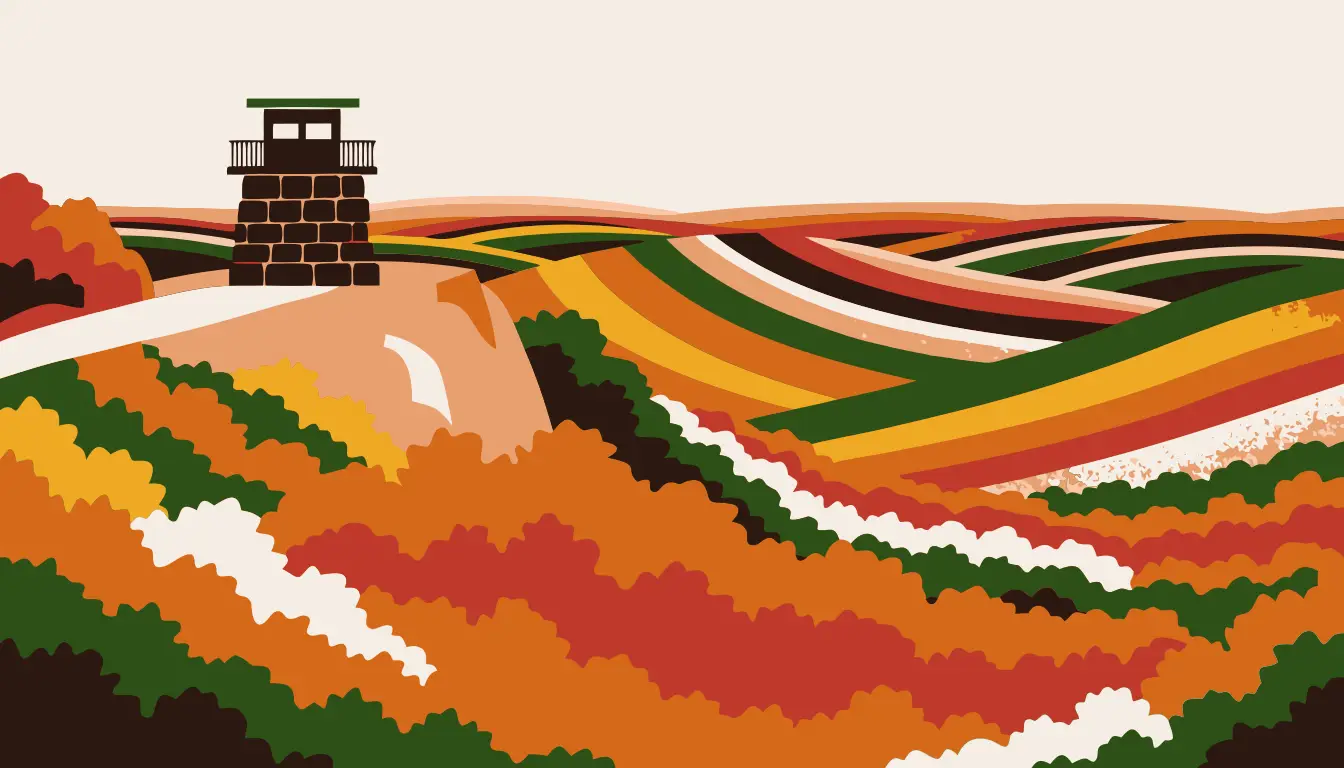
One of the best foliage viewpoints in the North Country is a five-minute drive from our lobby. Weeks State Park crowns Mt. Prospect just south of downtown — the 1912 summit lodge of John Wingate Weeks, the Lancaster native whose Weeks Act of 1911 created the White Mountain National Forest. The forest everyone drives north to photograph exists, in large part, because of a man from this town.
Beside the lodge stands a 56-foot stone fire tower, and from the top the view runs a full circle: the Presidential Range to the southeast, the Kilkenny country to the northeast, and the Connecticut River valley rolling west into Vermont. In the first week of October it is an almost unreasonable amount of color for one set of stairs. Go late afternoon, when the light comes low across the valley — then be back in town before dinner.
Scenic drives from the inn
Both of Lancaster’s highways are foliage routes. One gives you mountains, the other gives you the river.
Route 2 east: the Presidential Range show
Head east out of downtown toward Jefferson and the road climbs into open farm country with the Presidential Range stacked across the windshield — often with early snow on the summits while the valleys below are still in full color. It’s fifteen minutes of some of the best mountain-over-foliage views in the state, with pull-offs where you’d want them. If you’re up on a fall weekend with kids, Santa’s Village runs weekends into the fall right on this road.
Route 3 north: the Connecticut River valley
North out of town, Route 3 follows the Connecticut River through bottomland farms with Vermont’s hills burning on the far bank. It’s a softer, quieter kind of foliage drive — barns, river bends, no traffic. Detour to the Stark covered bridge, twenty-five minutes from the inn, where a white wooden bridge and a steepled church sit under a wall of color; it’s one of the most photographed corners of the North Country for a reason. Go early or late in the day and you have a real shot at moose — we wrote a guide to that too.
And yes, the Kancamagus
The Kanc deserves its reputation. From Lancaster it’s about an hour’s drive to its western end in Lincoln, which makes it an easy day trip — go midweek, leave early, and you’ll have a far better time than the Saturday crowd. But if you skip it entirely, you won’t feel shortchanged. Route 2 gives you the mountains without the brake lights, and Franconia Notch — forty-five minutes from us — splits the difference: big drama, shorter drive.
Book early. Foliage weekends fill.
We have 27 rooms. The two peak weekends — the last of September and the first of October — tend to book out well ahead, here and everywhere else in the mountains. If your dates are fixed, book now; our 72-hour cancellation window keeps the risk low. A few fits worth knowing:
- A weekend for two: the Standard Queen, from $99. Everything you need, nothing padded onto the bill.
- Two couples caravanning: the Deluxe Queen — two queen beds in our most spacious standard room, from $129.
- The full-week leaf peeper: the Extended Stay — full kitchen, living room, private entrance, free laundry, from $799 a week. Chase peak color across two weekends instead of gambling on one.
Traveling as a group — a photography club, a family reunion timed to the color? Five or more rooms on one invoice earns a group discount. Call and we’ll set it up.
What a fall evening here looks like
You come down off the tower or in from Route 2 around five. Walk three blocks to Centennial Park and say hello to the bronze fox — cast in 1913 by Anna Hyatt Huntington, the town’s symbol and our namesake. Then cross to the 1862 Mechanic Street covered bridge, five minutes on foot, where the Israel River runs under 160-year-old timber with the leaves coming down around it.
Dinner is a walk, not a drive. Copper Pig Brewery pours in the basement of an old brick bank beside the river; Smokin’ T’s does barbecue; the restored Rialto Theatre runs a movie with beer and wine if the evening turns rainy. Back at the inn, the fire pit on the patio gets lit on cool evenings — and every late-September evening up here qualifies. The Den, our speakeasy-style cocktail bar, is in the middle of a top-to-bottom renovation and reopens soon — foliage season is exactly what it’s being built for.
The bottom line
The White Mountains in fall are worth every mile of the drive. You just don’t have to watch them through a windshield in traffic. Base north, in a real town, where the color starts earlier, the roads stay open, and the evening ends at a fire instead of a parking lot.
Check availability for foliage season, or call us at (603) 788‑4921. If you’re aiming for peak, ask — we watch these hills every day, and we’ll tell you what we’re seeing.