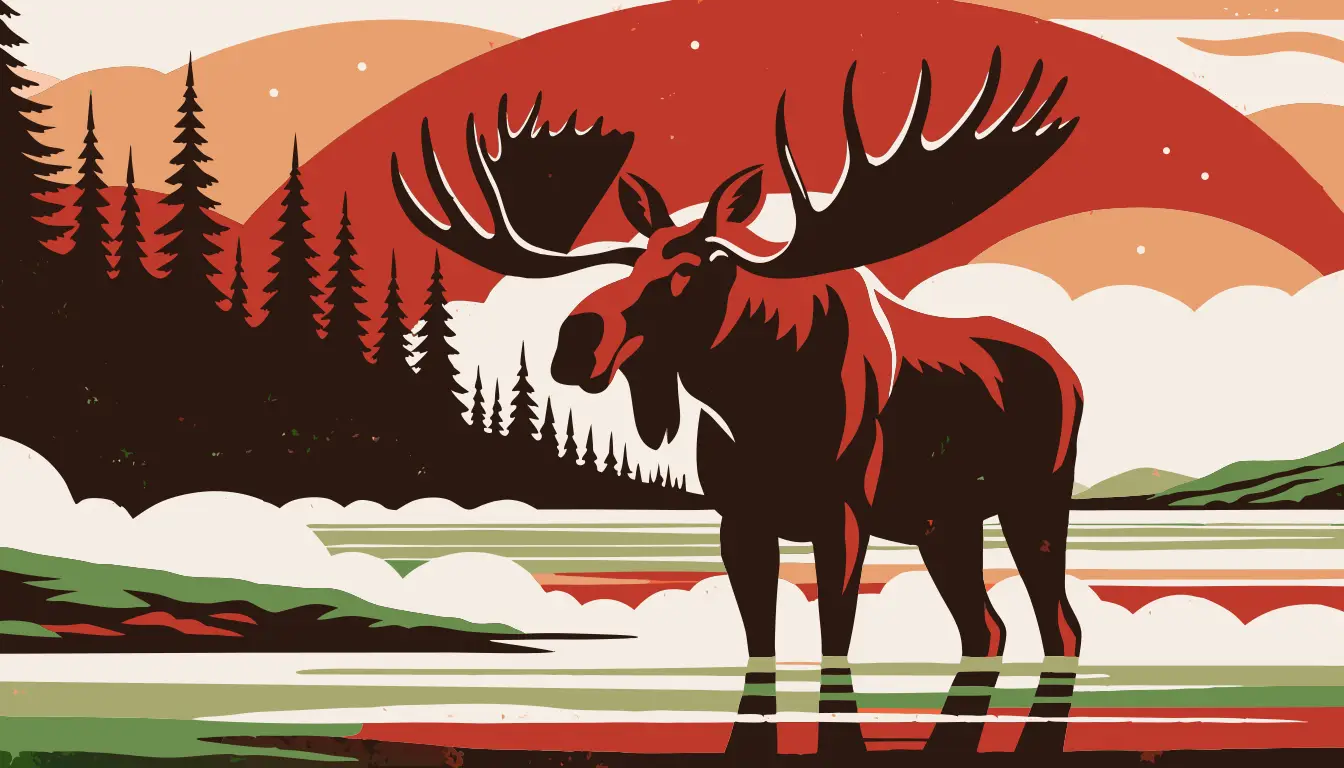
New Hampshire has moose almost everywhere north of the notches, but the numbers tell a lopsided story. The state’s moose population is concentrated in Coös County, and the farther north you drive, the better your odds get. Lancaster is the county seat and the southern doorway to the Great North Woods — which makes it a natural base for the one thing nearly every visitor asks us about: where can I actually see a moose?
Not a dark shape in someone else’s photo. A real one, standing in a bog at last light, steam coming off its back. That sighting is very achievable up here — if you go to the right roads, at the right hours, in the right months. This is the honest guide.
Why Coös County is moose country
Moose want three things: young forest to browse, wetlands to wade, and room to be left alone. Coös County has all three in quantities the rest of the state can’t match. This is working timberland — cut, regrown, cut again — and every regenerating clearing produces exactly the tender hardwood shoots a moose eats by the dozens of pounds per day. Fold in the bogs, beaver ponds, and slow rivers threaded through the whole county, and you have some of the densest moose habitat in New Hampshire.
Which is why the classic local advice holds: don’t hunt for moose in the busy corridors around the southern White Mountains. Drive north. The country above Lancaster — Groveton, Stark, Colebrook, Pittsburg — is where a sighting stops being luck and starts being probability.
Moose Alley: the classic drive
Ask anyone in the North Country where to see a moose and you’ll get the same answer: Moose Alley — the stretch of Route 3 that runs north from Pittsburg village, past the Connecticut Lakes, to the Canadian border. It’s about 90 minutes north of Red Fox Inn, and it’s the best-known moose-watching road in the state.
The road threads through exactly the habitat moose love: boggy lowlands, regenerating cuts, and wet roadside ditches where minerals collect. In late spring and early summer, moose come right to the shoulder for the sodium left behind by a winter of road treatment. Locals treat the Alley the way other places treat a scenic overlook — you drive it slowly, windows down, everyone scanning.
How to run it: get to Pittsburg by late afternoon, top off your gas tank (services thin out fast north of the village), and drive the Alley in the last two hours of daylight. Keep your speed well down. Use the pull-offs. If a moose appears, you’ll usually have time to stop properly — they don’t tend to hurry, and neither should you.
When will you actually see one?
The months that work
- Mid-May through July — the best stretch of the year. Moose work the roadside ditches for salt, cows are out with new calves, and the long evenings give you a wide viewing window.
- September and October — the rut. Bulls are moving, antlers are full grown, and Coös County happens to be at peak foliage at the same time. A dusk run up Route 3 in early October is two trips in one.
- Midsummer middays and deep winter — honest answer: poor. In August heat, moose hold to shade and water during the day; in winter they stay in the softwood cover, far from the road. Adjust your expectations, not just your schedule.
The hours that work
Moose are crepuscular — most active in low light. The first hour after dawn and the last hour before dark are worth more than the entire middle of the day combined. If you can only make one run, make it the evening one: leave Lancaster around 4 PM in summer, be on the Alley by 6, and drive it slowly until the light goes.
Roadside safety: this part is not optional
Every year, New Hampshire drivers collide with moose, and the physics are terrible. An adult bull can weigh a thousand pounds, and most of that mass rides on long legs at bumper height — which means in a collision the body comes down at windshield level. Their coats are nearly black, and unlike deer, a moose’s eyes usually sit above your headlight beam, so you often get no eyeshine and no warning. The state’s famous BRAKE FOR MOOSE signs are not a souvenir slogan. They are a genuine warning, and the North Country takes them seriously.
- Never stop in the travel lane. Not even for thirty seconds, not even when a moose is posing. Pull completely off onto a shoulder or into a pull-off and put your hazards on.
- Slow down at dusk and after dark, especially through posted moose-crossing corridors. Driving below the limit on Moose Alley at twilight is normal behavior up here, not an annoyance.
- Split the job. The driver watches the road ahead; passengers scan the ditches and tree lines. That division of labor finds more moose and prevents more accidents than anything else you can do.
- If a moose is in the road, stop and wait. Don’t honk, don’t inch forward. It will cross on its own schedule.
How close is too close?
Your car is the best wildlife blind ever built. Stay in it. A moose that tolerates a parked vehicle at a respectful distance may react very differently to a person walking toward it, and moose can be genuinely dangerous when they feel pressed — a cow protecting a calf in early summer, or a bull in the fall rut, will charge. If you’re on foot, keep a long distance, let the zoom lens do the closing, and watch the animal’s body language: ears pinned back or raised hackles mean back away now, and put something solid between you.
The simplest rule covers everything: if the moose changes its behavior because of you, you’re too close. Never feed one, and never get between a cow and her calf.
Making a day of it from Lancaster
The drive north is half the trip. Route 3 out of Lancaster follows the Connecticut River valley through Groveton and North Stratford to Colebrook, then climbs to Pittsburg — big river views, farm country, and progressively fewer buildings the whole way. Spend the afternoon around the Connecticut Lakes, run Moose Alley at dusk, then drive home carefully in the dark with the same rules you used to find the moose.
You’ll roll back into Lancaster late, and that’s where basing here pays off. The fire pit on the patio is lit on cool evenings, and the front desk is open 24 hours — no side-eye for a late return. (The Den, our cocktail bar, is under renovation and reopening soon — the post-sighting nightcap is on its way back.) If you’d rather chase the dawn window instead, the motor-lodge format works in your favor: your car is parked at your door, so a 4:30 AM departure disturbs no one. The Great North Woods Welcome Center sits directly behind the property — an easy first stop before you head up.
One more honest local note: moose live all over Coös County, and the back roads around Lancaster and Jefferson do produce sightings at dusk — but nobody can promise you one close to town. For probability, go north. For everything else worth doing between runs, start with our guide to things to do in Lancaster.
Where to land afterward
- Couples on a moose-and-foliage weekend: the Deluxe Queen — two queens and the most spacious of our standard rooms, from $129.
- Photographers and early risers staying several nights: the Extended Stay (Ground Level) — full kitchen for pre-dawn coffee and a packed breakfast, private entrance, free on-site laundry. From $129 a night or $799 a week.
- Everyone else: fiber Wi-Fi to upload the photos, individually controlled heat for October mornings, and lobby coffee from 7:30 AM. Browse everything within reach of the inn to fill the rest of the trip.
The bottom line
Seeing a moose in New Hampshire is not a lottery ticket. It’s a formula: Coös County, the right months, the last light of day, and a slow car on Route 3 north of Pittsburg. Lancaster puts you at the bottom of that formula with a real downtown to come home to.
Check availability for your Great North Woods trip, or call us at (603) 788‑4921. We’ll point you north.